What is a Concrete Wall Anchor and How Does it Work?
Concrete Wall Anchors are essential in construction and renovation. These anchors provide stability and support, preventing structural failure. Industry expert Robert Langston states, "The right Concrete Wall Anchors can make or break a project’s integrity." His insight emphasizes the importance of quality when selecting anchors.
When dealing with heavy loads or mounting equipment, understanding how Concrete Wall Anchors work is crucial. They rely on friction or expansion to secure themselves within the concrete. Many may underestimate their value, potentially leading to unsafe conditions. Choosing the right type is vital.
Moreover, not all anchors are suited for every project. Some might require specific installation techniques. This can lead to errors if overlooked. In the world of construction, every detail counts. Concrete Wall Anchors are often taken for granted, yet their role is indispensable.
What is a Concrete Wall Anchor and Its Primary Function?
Concrete wall anchors serve a critical purpose in construction and home improvement projects. These anchors are designed to provide a secure fastening point within concrete walls. Their primary function is to hold heavy fixtures, like cabinets or shelves, firmly in place. When installed correctly, they distribute the load evenly, preventing any potential damage to the wall or the mounted object.
Using concrete wall anchors requires careful consideration. It's essential to select the right type for your specific application. For instance, some anchors expand once inserted, while others use adhesive for holding power. Misjudging the size or weight capacity can lead to failures. This could result in falling items or structural damage. In many cases, people underestimate the importance of proper installation. A poorly anchored fixture can tilt or worsen over time.
Installation often comes down to the drill and the anchor type. It’s common to see uneven placements or incorrect depths. Engaging with guides and tutorials is helpful, but personal judgment is crucial. The goal is to achieve robustness and reliability. Even small mistakes can lead to bigger problems down the line. It’s a process that requires practice and careful thought.
What is a Concrete Wall Anchor and How Does it Work?
| Dimension |
Description |
| Type |
Expansion Bolt |
| Material |
Steel |
| Size Range |
1/4" to 1" Diameter |
| Load Capacity |
Up to 5000 lbs (depending on type) |
| Installation Method |
Drilling and insertion, followed by expansion |
| Typical Uses |
Mounting shelves, heavy equipment, and fixtures |
| Key Advantage |
Secure hold in concrete, can withstand heavy loads |
| Common Installation Tools |
Hammer drill, wrench, and torque wrench |
Types of Concrete Wall Anchors: A Comprehensive Overview
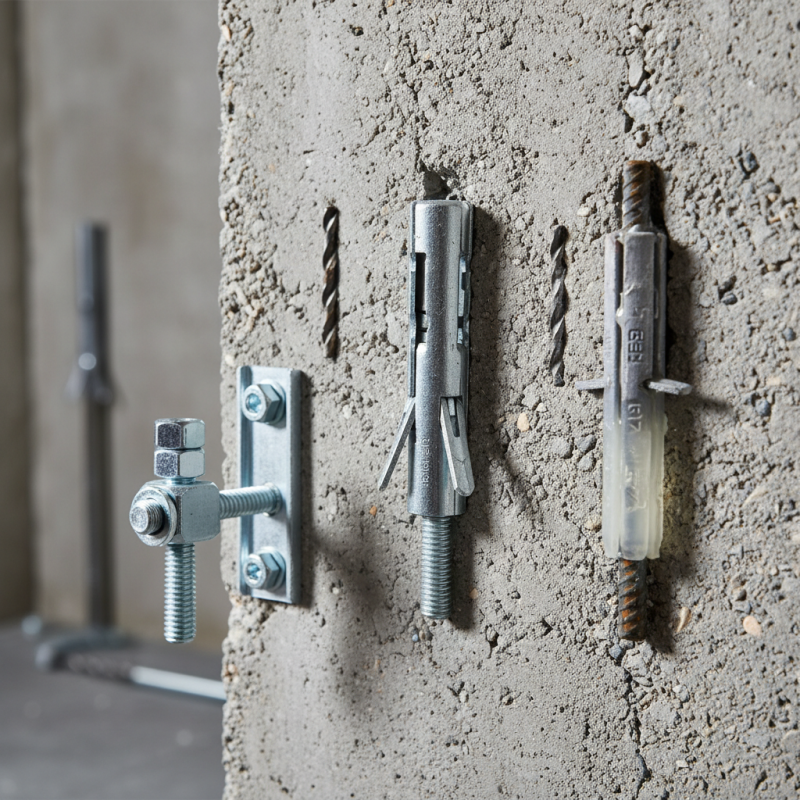
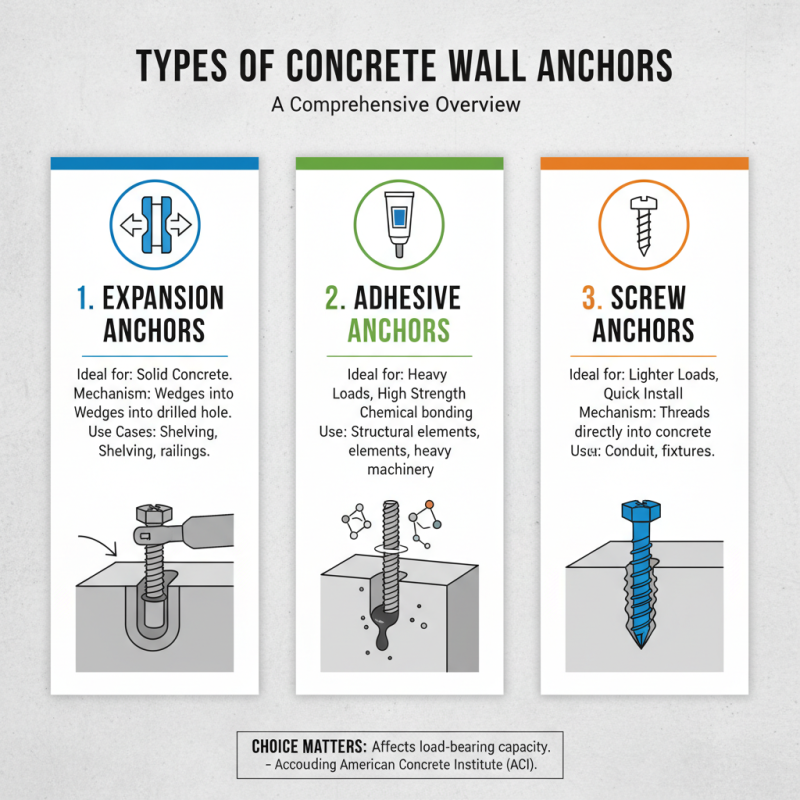
When discussing concrete wall anchors, understanding the types is essential. There are multiple variations, each designed for specific applications. Some common types include expansion anchors, adhesive anchors, and screw anchors. Expansion anchors work well in solid concrete, while adhesive anchors provide superior strength for heavy loads. According to the American Concrete Institute, the choice of anchor can significantly impact the load-bearing capacity.
Installing these anchors requires careful consideration of various factors. For instance, the thickness of the concrete slab can influence anchor performance. The Concrete Reinforcing Steel Institute suggests assessing the embedment depth as well. Anchors can fail if the installation is not accurate. It's crucial to follow guidelines to avoid costly mistakes. For instance, an improperly installed screw anchor can lead to a complete structural failure.
Some professionals argue that certain anchors are underutilized. For example, while adhesive anchors often yield higher performance, they require longer curing times. This can deter contractors keen on quick results. There's a balance between efficiency and effectiveness that needs reflection. The industry continues to evolve, emphasizing the need for ongoing education and best practices. Understanding these nuances can lead to better decisions in anchor selection and application.
How Concrete Wall Anchors Work: Mechanisms and Installation Process
Concrete wall anchors play a vital role in construction and home improvement. They secure various fixtures to concrete surfaces. The mechanisms generally involve friction, expansion, or adhesive bonding. Understanding how these mechanisms function is crucial for effective installation.
The installation process begins with selecting the right anchor type. A hole must be drilled into the concrete. The diameter and depth of the hole vary depending on the anchor's specifications. In the case of expansion anchors, they expand when a screw is tightened. This expansion increases friction against the concrete.
Adhesive anchors, on the other hand, rely on strong bonding agents. These are injected into the drilled hole before inserting the anchor.
Tips: Always wear safety gear when drilling. Dust and debris can cause injuries. Check the concrete's condition as well. Cracked or old concrete may not hold anchors effectively. Use a level to ensure proper alignment of fixtures. When installing anchors, doing it slowly helps avoid mistakes. A rushed job may yield poor results and require redoing the task.
Load Capacity and Performance of Concrete Wall Anchors: Key Metrics
Concrete wall anchors play a crucial role in securing various fixtures to walls. Understanding their load capacity helps in selecting the right anchor for specific tasks. Load capacity refers to the maximum weight an anchor can hold without failure. It is influenced by several factors, such as the type of concrete and anchor design.
When selecting suitable anchors, it’s essential to evaluate the type of load they will bear. For example, some anchors are designed for heavy-duty applications while others are better for lighter loads. Knowing these metrics can prevent potential structural issues. Always consider the environment where the anchors will be installed. Wet or unstable conditions may impact performance.
**Tips:** Test the anchor in a small area first. Observe how it reacts to weight before full installation. Always read the manufacturer’s guidelines, as they offer specific load ratings. While it’s tempting to exceed recommended capacities, doing so can lead to regrets.
Concrete Wall Anchor Load Capacity
This chart illustrates the load capacities of different concrete wall anchor types. The values represent the maximum weight each type can support, showcasing the variations in performance across anchor designs.
Common Applications of Concrete Wall Anchors in Construction Projects
Concrete wall anchors play a vital role in construction projects. These anchors provide secure attachment points for various applications. They are widely used for mounting heavy equipment, securing wall panels, and installing fixtures. In a report by the Construction Industry Institute, concrete anchors account for about 15% of fastening solutions used in commercial buildings.
In residential projects, these anchors are essential as well. They allow homeowners to install shelves, cabinets, or artwork securely. A study shows that improper installation of anchors can lead to 30% of failures in wall-mounted systems. This highlights the importance of using the correct type of concrete anchor. Many workers often overlook this, which can result in structural issues down the line.
The methods for securing these anchors can vary. Some require drilling, while others utilize adhesive bonding. The choice largely depends on the project requirements. Some installations may be considered overly complicated due to lack of expertise. Understanding the specific needs for each project is crucial for success.